I recently found a journal from 2016 where I spent three entire pages agonizing over whether to text someone I was in a situationship with 💀 it’s safe to say my 'inner work' has evolved since then.
We’ve all heard that journaling is the 'holy grail' of self-care. It’s right up there with drinking enough water and getting eight hours of sleep. But if you’re like me, you want to fully understand why journaling helps and what the benefits are before commiting to a new habit.
Here’s the thing: Journaling isn’t about being a great writer, it's about realizing things. (I wonder if Kylie Jenner was journaling a lot in 2016 during her famous "year of realizing stuff")
But 'realizing stuff' is not a joke! Realizing means to "make real." Through journaling we can shape our core beliefs more effectively than through any other method. By putting down in words or finding words that align with beliefs, you can change your beliefs. And if you change your beliefs, you change your behavior. After your behavior changes, little by little, your life completely transforms. For example, if you struggle with not thinking you're worthy, you can start formulating reasons and evidence for why you are worthy. Building this belief will change your behavior, which will change who you surround yourself with and more.
(That situationship journal entry was precisely about being worthy. It was still really helpful for my growth even if it was a bit cringe to read years later.)
As long as you are actively reflecting about tangible new ways to think, you can grow and evolve in incredible ways. I'm going to walk you through the cognitive science aspects and then get into how journaling and reflection really work, so that you can find a routine that fits your life.
The Mental Health Benefits of Journaling
When we talk about what the benefits of journaling actually are, we have to start with the brain. According to a concerning new study about beliefs and reasoning, we rely more on established beliefs than reality to make decisions, even if reality counters our beliefs. Children younger than 8 seem to not have this "curse-of-experience" cognitive effect. After age 8, we start to live on auto-pilot and assume we know how almost everything works. But we don't. This is where journaling helps: reflection stops this automatic behavior in its tracks. Even just asking Why? regularly can help you fight against this cognitive effect.
Emotional Regulation and Stress Reduction
Ever had a day where you’re just meh but you can't pin down why? Writing (or even just identifying your mood) acts as a pressure valve. By labeling your emotions, you move the processing from the amygdala (the 'fight or flight' center) to the prefrontal cortex (the 'rational' center). This shift helps you feel more in control and less overwhelmed by your feelings.
Boosting Self-Awareness
As I touched on previously, most of us spend our days on autopilot. We react to emails, we scroll, we eat, we sleep. Journaling and reflecting are different from the autopilot activities I just mentioned. They are a 'pattern interrupt.' Reflecting requires you to take a step back and not just ask "What should I do next?" but "Why?"
RuPaul's Perspective on Reflection
 RuPaul being interviewed by Paul Holdengräber in 2015. Source: NYPL
RuPaul gave a famous talk at the New York Public Library in 2015 where he expounded on how taking the time to zoom out of your life and see it as a play is a key aspect of his own journey of self-reflection and personal growth. This unique Shakespearean approach moves you from being the main character to being the author of your life. Not just that, you can observe and analyze relationships and dynamics much better when you take a step back. That's hard to do in the middle of bickering with your partner. Actively engaging with ideas and beliefs through journaling takes you a step further, and the difference is the agency it gives you to build a better life, with better relationships, dynamics and patterns.
Why Reflection is the Core (Not the Writing)
One of the biggest misconceptions is that the 'writing' part is the benefit. In reality, the benefit comes from reflection.
Research has shown that it’s the act of looking back and processing your experiences in a structured way that leads to growth.
(This is why I think prayer helps some people so much. If prayer is part of your faith or spirituality journey, you'll notice that at its core, its a structured way to articulate your struggles, express optimism, and hand the load off to a higher power. If you're not religious, don't worry, there are plenty of ways to reflect.)
One of the most common ways to reflect is journaling, but honestly, most people can't stay consistent with journaling, even if they try their best. It takes a certain type of person who really enjoys writing to maintain that type of habit. I tried morning pages (I wrote a whole review of my morning pages experience here, and I felt like I was forcing myself to write every day.) Not only do you feel like you have to write a novel to get to the point, it feels like work .. or worse, it reminds you of homework.
I genuinely think if it doesn't come naturally to you, let it go.
Writing is not required for a deep, fulfilling reflection practice.
This is where the idea of 'wordless' or guided journaling comes in. If the goal is to 'realize stuff,' you don't necessarily need a pen and paper. You need the right questions, app or worksheet to trigger your brain.
While apps can feel fatiguing in their own right, I try to stay open-minded especially if an app is ad-free and doesn't try to rope me into a subscription.
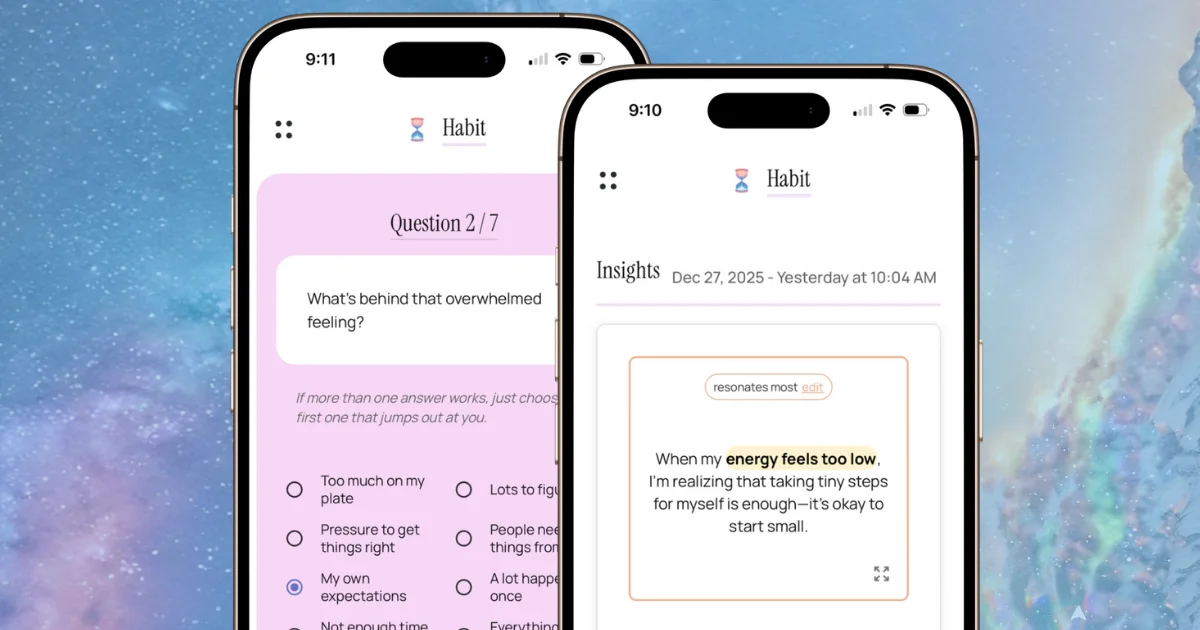 An example of a flexible-pricing digital journal that helps you do a 'pattern interrupt' on your routine. Source: Habit
"Reading can teach you the best of what others already know. Reflection can teach you the best of what only you can know." James Clear
What Are the Benefits of Journaling and Reflection? A Major Benefit is Making Better Decisions
Have you ever made a decision in the heat of the moment and regretted it five minutes later? We’ve all been there. One of the hidden benefits of journaling is that it creates a 'paper trail' (digital or physical) of your logic.
- Clarifying Thoughts: When you have to articulate why you’re upset or what you want, you’re forced to be honest.
- Historical Perspective: Looking back at how you handled a similar situation three months ago gives you the confidence to handle the current one.
- Objective Viewing: Stepping back to 'view' your life through a journal entry makes you the observer rather than the victim of your circumstances.
The 'Look Back' Effect: Weekly and Yearly Reviews
There is a specific kind of magic in looking back on your week or year. Spotify tapped into this with their famous Wrapped feature on their app. It’s easy to feel like you haven't accomplished anything when you're in the daily grind. However, when you review your check-ins, you see the progress.
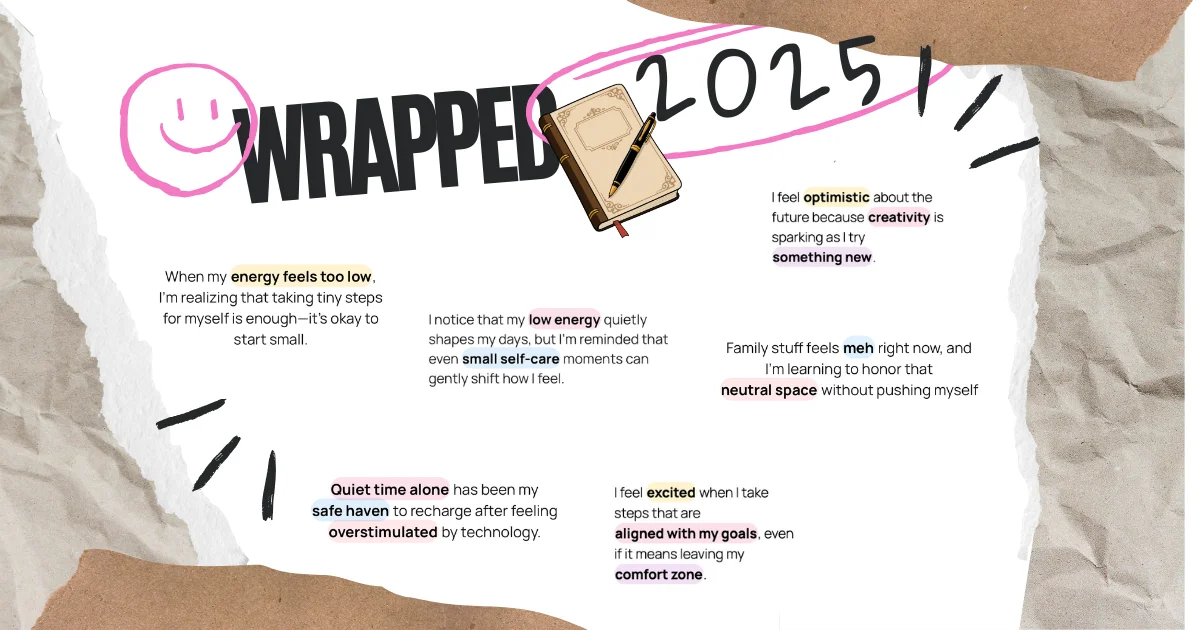 A look back at a year of digital journaling.
How to Get the Benefits Without the Burnout
If the idea of a blank page makes you want to close your laptop and take a nap, you’re not alone. The friction of 'what do I write?' often outweighs the benefits of the practice.
To make reflection stick, try these tips:
📝 Use prompts
Stop starting with a blank page. Use journaling prompts that do the heavy lifting for you. Here's a journal prompt generator that let's you pick the topic, theme, style and even if you want a quick or extended writing session.
🗣️ Start Yapping
If you're tired of typing, look into the audio recording apps on your phone. Some of them will even create a transcript for you. There's some simple automations that can do this on most phones, so you might not even need a new app.
🪄 Try wordless journaling
You don't need to write or type at all! Sometimes a 7-question tap-through app like Habit is more effective than forcing yourself to write.
| Reflection Tools: | Traditional Journaling | Start with a Prompt | Audio Journaling | Guided Check-ins (Habit) |
|---|
| Time Required | 15–30 minutes | 10–20 minutes | 5–10 minutes | 2–3 minutes |
| Mental Effort | High (Blank page stress) | Medium (Directed focus) | Low (Stream of consciousness) | Very Low (Tap-through) |
| Consistency | Hard to maintain | Moderate | Depends | Easy to maintain |
Final Thoughts: Just Start Reflecting
At the end of the day, the benefits of journaling are all about creating a better relationship with yourself. Whether you’re using a leather-bound book or a guided check-in app, the goal is the same: to stop, breathe, and realize what’s actually going on in your world.
Your future self (the one in 2029 looking back at your 2026 self) will thank you for it.