Older Adults Were 4× More Likely to Try AI Journaling
Our 2,000-person journaling study found that half of participants 55+ would try the AI-enabled reflection—four times the rate among younger participants.

Loading content...
 Habit
HabitOur 2,000-person journaling study found that half of participants 55+ would try the AI-enabled reflection—four times the rate among younger participants.
"Older Adults Were 4× More Likely to Try AI Journaling" — Habit Blog — https://habit.am/blog/are-older-adults-more-open-to-ai-journaling

Founder of Habit and former researcher at the UCLA GameLab, Noemi specializes in the intersection of behavioral psychology and game design. She pioneered the application of 'game loops' to mental wellness, creating tools that make habit formation intuitive rather than clinical. Her insights on the tech industry have been featured in The Guardian.
View all articles by Noemi Titarenco →
We assumed younger adults would be first in line for AI journaling.
We were wrong.
In our 2,000-person Lyssna study, participants 55+ were four times as likely to say they would try an AI-enabled guided reflection. Half of the older group chose “Appealing — I’d try it,” compared with one in eight participants under 55.
Older adults were not reluctant. They were decisive.
Participants saw a concept for Habit, a guided journaling app that turns seven multiple-choice answers into a personalized reflection in about two minutes.
The study included 2,000 participants. The age breakdown below comes from a representative 40-response analysis sample drawn from that larger study:
| Response | Ages 26–54 (n=32) | Ages 55–73 (n=8) |
|---|---|---|
| Appealing — I’d try it | 4 (12.5%) | 4 (50%) |
| Interesting, but show me an example | 20 (62.5%) | 2 (25%) |
| Prefer writing my own thoughts | 5 (15.6%) | 2 (25%) |
| Confusing | 3 (9.4%) | 0 |
| Broadly interested | 24 (75%) | 6 (75%) |
Overall interest was equally strong: 75% in both age groups either wanted to try the product or wanted to see an example.
The difference was hesitation.
Nearly two-thirds of participants under 55 stopped at “show me an example.” Only one-quarter of the older group did. The 55+ participants moved from interest to intent much faster.
That is the headline: age did not reduce openness to AI-enabled reflection. In our study, the oldest participants had the highest immediate trial intent.
In June 2026, we ran a 2,000-participant Lyssna research study. Participants viewed a five-second concept screen and answered four questions:
Our research archive preserves a representative 40-response sample with the participant-level data needed for the age comparison. Within that sample, the concept was easy to understand:
This was not a solution looking for a problem. Participants recognized the need, understood the category, and saw a place for a quick reflection in their lives.
The strongest open-ended responses from older participants focused on the practical value:
“Journal without writing single word.”
“No typing required.”
“7 question AI powered journal that turns my answers into insights.”
These responses did not celebrate AI for being futuristic. They identified a useful job: make reflection faster, easier, and less dependent on writing.
That may explain why the older group was more ready to try it. The product did not ask them to learn a complicated new behavior. It removed work from a familiar one.
The lesson is bigger than journaling. People do not need to be enthusiastic about AI as an identity or cultural movement. They need to see what it does for them.
Technology companies often treat older adults as late adopters by default. That framing can become self-fulfilling: products are designed for younger users, marketed with technical language, and then interpreted as proof that older people are uninterested.
Our results point in the opposite direction.
The older participants did not need more hype. They needed a clear outcome:
Once that value was visible, half said they would try it.
Technical familiarity and product willingness are not the same thing. A younger person may understand AI perfectly and still prefer a notebook. An older person may care very little about the model and immediately value the result.
Across the age-analysis sample, the most common response was “Interesting, but I’d need to see an example first.” Twenty-two people—55% of the sample—selected it.
That is not rejection. It is a request for evidence.
People understood that they would answer questions, but many could not picture the personalized reflection waiting at the end. The product promise was clear; the payoff was still abstract.
The fix is not more AI language. It is a concrete demonstration:
That lesson now shapes our guided journaling overview and walkthrough of how Habit works. In a category built on trust, showing the experience is stronger than describing the technology.
A second 50-response cut from the same 2,000-person research study asked participants to rate six possible journaling capabilities.
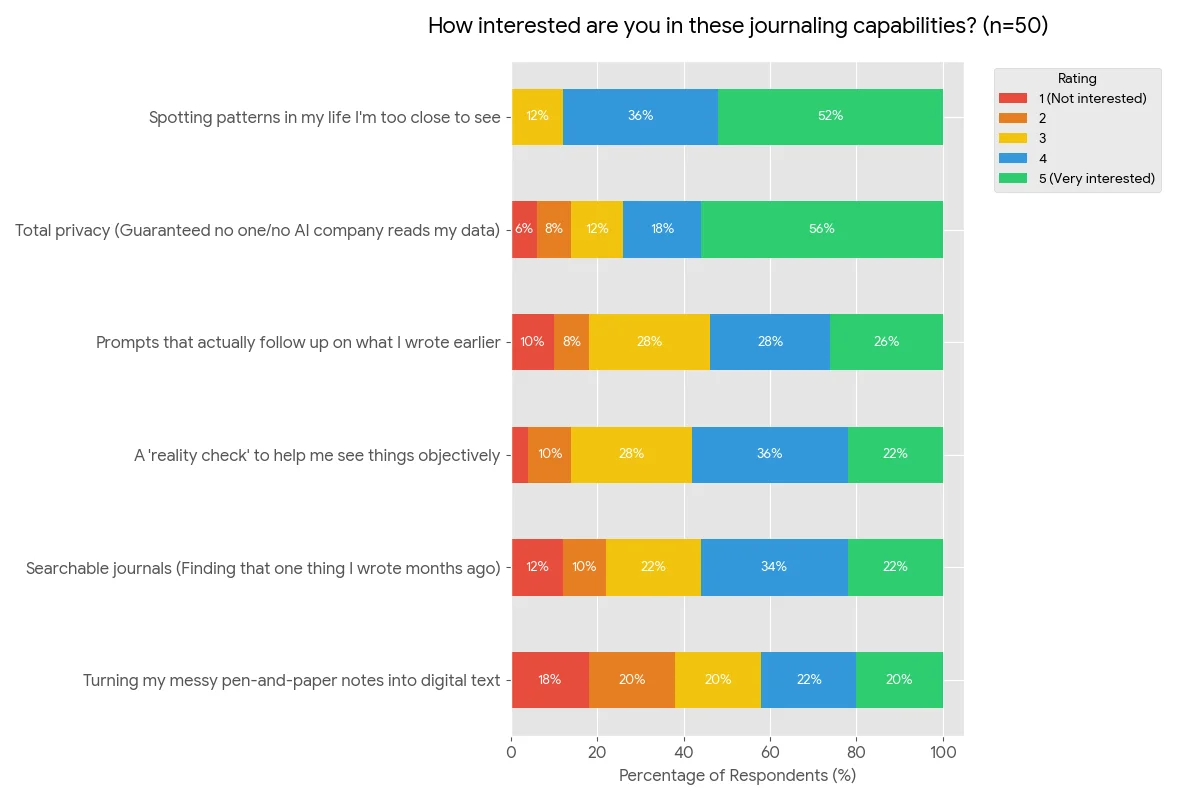
Two priorities stood well above the rest:
Participants were less excited by AI as a writing or transcription machine. Turning handwritten notes into digital text received the weakest response.
The preferred role was clear: help me see something meaningful, then protect what I shared.
This is a more useful definition of AI journaling than “a chatbot that talks back.” AI can guide questions, connect patterns, organize insights, or work quietly behind a structured check-in. Our guide to how AI journaling tools work explains the differences.
Older adults are a real audience for AI-enabled reflection. Do not exclude them through tiny text, unexplained interactions, youth-coded marketing, or assumptions that they need to be convinced AI matters.
Show the value. Make the flow simple. Let the result speak for itself.
“Spot patterns in your life” is concrete. “AI-powered insights” is not.
People responded to a two-minute reflection because they could imagine using it. The model behind the experience was secondary.
Journaling data can include the most sensitive material a person records. Privacy cannot be fine print beneath the feature list.
People should know where their entries go, whether humans can access them, whether their data trains models, and how it can be deleted. Those questions belong in the product experience as well as the privacy policy. Our guide to ethical concerns in AI mental health apps covers what users should look for.
More than half of our concept-test participants wanted an example. AI wellness products should earn trust through visible behavior: clear inputs, understandable outputs, transparent boundaries, and a chance to try the experience.
This was a substantial 2,000-person product-research study, not a clinical outcome study.
The participant-level file used for this article is a representative 40-response extract from the full study. It contains women in the United States, ages 26–73, who were college graduates, earned a household income above $100,000, were employed or self-employed, and described their technical proficiency as intermediate or advanced. The 55+ subgroup in the extract contained eight people.
The appeal question also described the guided reflection experience rather than asking, “Do you trust AI?” This makes the study strongest as evidence of willingness to try an AI-enabled experience, not as a blanket measure of attitudes toward every AI mental health tool.
The percentages reported in this article come from the representative extract rather than a fresh cross-tab of all 2,000 participant rows. That limits the precision of the age percentages, but it does not change the direction of the finding: older adults showed the strongest immediate willingness to try the product. A full-cohort age analysis would be the right next step for producing tighter estimates.
Older adults are not an afterthought for AI journaling.
In our study, they were just as interested as younger participants and four times as likely to say they would try the experience immediately.
The winning proposition was not “AI is the future.” It was simpler:
Reflect without a blank page. See a pattern you might have missed. Keep the experience private.
Build that clearly and responsibly, and openness to AI-enabled reflection may be much broader—and much older—than the technology industry assumes.

Marc Andreessen's call for zero introspection mistakes rumination for self-knowledge. Lao Tzu, Sun Tzu, and Marcus Aurelius offer a more useful distinction.
Daily journaling works best when you focus on consistency, not volume. Learn simple techniques to show up regularly and build a meaningful record over time.


You cannot find Manifestation of Creation on Amazon or in bookstores. That is because it appears to be a fake book sold through bot-driven comments and sketchy storefronts. Here is what is really going on.

Free Resources
For Professionals
© 2026 Habit. All rights reserved.
Build version: v2.18.8