Wordless Journaling: The Art of Self-Reflection Without Words
I wanted to explore a unique alternative to traditional writing-based approaches to see if you could still get the benefits and therapeautic effects of journaling.

Loading content...
 Habit
HabitI wanted to explore a unique alternative to traditional writing-based approaches to see if you could still get the benefits and therapeautic effects of journaling.
"Wordless Journaling: The Art of Self-Reflection Without Words" — Habit Blog — https://habit.am/blog/wordless-journaling

Former Licensed Clinical Social Worker (LCSW) with a Master’s in Psychology from Georgia State University. Sam spent a just under a decade in clinical practice focusing on Cognitive Behavioral Therapy (CBT.) Passionate about subclinical conditions and improving quality of life through quality relationships.
View all articles by Sam Ramirez →
In a world saturated with words (texts, emails, meetings, and conversations) sometimes the most profound self-reflection happens in silence. Wordless journaling offers a powerful alternative to traditional writing-based approaches, providing a path to emotional awareness and personal insight without the pressure of verbal expression.
Wordless journaling is the practice of using non-verbal methods to document thoughts, feelings, and experiences. Instead of writing paragraphs or answering prompts with words, you react to prompts or questions to capture your inner world. This approach bypasses the cognitive load of language and how to phrase things and taps directly into emotional and intuitive knowing.
The core principle of wordless journaling is simple: respond instead of write. Rather than composing sentences or paragraphs, you engage with prompts through intuitive selection. This could mean:
Apps like Habit have perfected the wordless journaling experience by creating a seamless flow that feels more like a conversation than a writing exercise. Here's what makes it work:
Start with simple, surface-level questions that naturally deepen based on your responses. Each answer unlocks a more personalized follow-up, creating an organic exploration of your inner world without the pressure to "come up with something."
The system learns from your patterns and adjusts question types and depth based on your emotional state. Some days you might explore light reflections, while other sessions naturally guide you toward deeper insights, all without you having to decide which path to take.
Instead of requiring you to articulate conclusions, the system synthesizes your responses into clear insights that feel authentic. It's like having your own realizations reflected back to you without the mental work of formulating them into words.
Research on cognitive load theory by Sweller (1988) and emotional processing by Pennebaker (1997) suggests that reducing cognitive load during reflection can lead to:
While anyone can benefit from this approach, it's particularly powerful for:
If you're used to traditional journaling, the shift to wordless approaches might feel strange at first. Start by:
Wordless journaling represents an evolution in how we approach self-awareness. By removing the writing barrier, we make emotional regulation and personal growth accessible to everyone, regardless of writing ability, cognitive style, or energy levels.
The result isn't a diluted form of journaling, but rather a more direct path to the insights and self-understanding that traditional methods often promise but don't always deliver for everyone.

Our 2,000-person journaling study found that half of participants 55+ would try the AI-enabled reflection—four times the rate among younger participants.

Marc Andreessen's call for zero introspection mistakes rumination for self-knowledge. Lao Tzu, Sun Tzu, and Marcus Aurelius offer a more useful distinction.
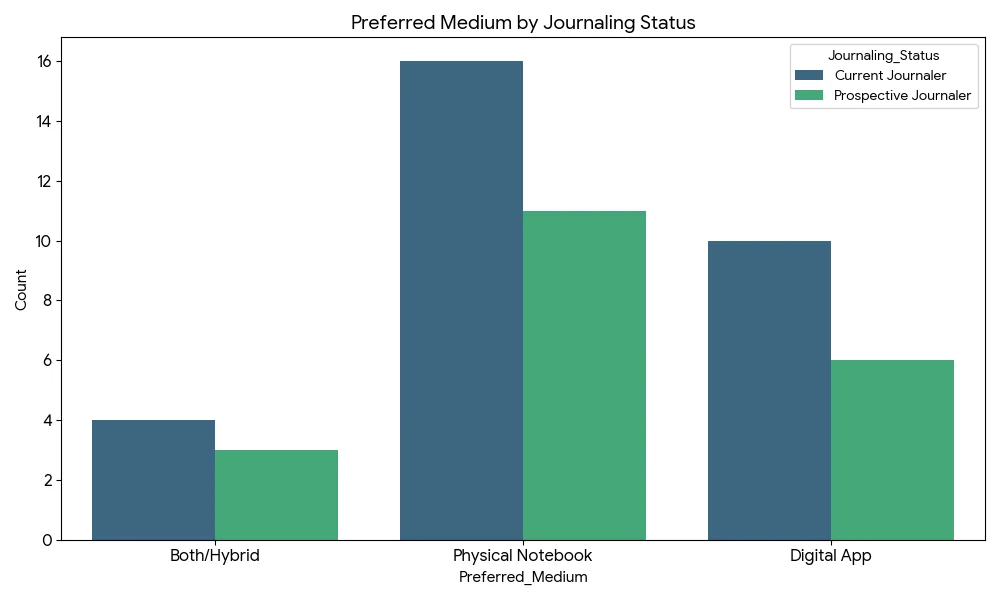
Daily journaling works best when you focus on consistency, not volume. Learn simple techniques to show up regularly and build a meaningful record over time.

Free Resources
For Professionals
© 2026 Habit. All rights reserved.
Build version: v3.0.0