New: try the interactive version. Use the private tool to write things down. Then stop, choose one small next step, or open a guided check-in. Prompts can help when a blank page feels hard. No signup required. Try the guided brain dump tool →
If you are an overthinker, your brain is rarely quiet. You replay conversations, predict worst-case outcomes, and spend more time deciding than doing. By the end of the day, you feel mentally exhausted, even if you did not make much progress.
The good news is that mental clarity is not a personality trait you either have or do not have. It is a skill you can build with the right structure.
Here is a simple, repeatable system to reduce mental noise, make decisions faster, and stay focused — without trying to empty your mind or become a different person.
There is also a free A4 brain dump worksheet (PDF) that matches the first two steps. You will find it in the printable section further down the page ⬇️ — with a one-click download (no email required).
The Mental Clarity Framework
Use this when your head feels crowded or indecision starts spiraling. Steps 1 and 2 match pages 1–2 of the printable (brain dump + five-column sort); the PDF also adds a short Focus page. The sections after step 2 help you act on what you sorted.
1. Brain dump — 10 minutes (Page 1)
Your first move is not solving everything. It is capturing everything.
Set a 10-minute timer. Then write down everything that pops into your head: things you need to do, thoughts you keep thinking about, worries, ideas you do not want to forget — anything.
Do not sort yet. Just extract.
The brain dump works because your brain is excellent at generating thoughts but not at storing them reliably. When you write down everything that is nagging at you, the background noise in your head gets quieter. You are not solving anything yet — you are just getting it out of the way so you can think.
2. Now, sort — five columns (Page 2)
Once the timer stops, put every item from the brain dump into one category. If you use the PDF, cross each line off page 1 once it has a home on page 2.
- Action: needs a concrete next step (even a small one).
- Decision: you cannot act until you choose something (often reversible — use the filter below).
- Later: not for today — deferred, waiting on someone or a date, or parked on purpose so it stops hijacking your attention.
- Let go: not yours to carry, not worth acting on now, or you are choosing to release it from today's mental load (guilt, hypotheticals, "should" items you will not actually do).
- Now: what you will engage first in this session or today — your immediate focus lane.
This is where clarity starts. "I am overwhelmed" becomes a short list with a shape.
If something belongs in Later or Let go, stop treating it like it is Now or Action for today.
3. Use a 2-level decision filter (especially for Decision)
Overthinkers burn energy on low-impact choices and then feel depleted for important ones. Decision fatigue is real: every small choice you make — what to eat, what to wear, which tab to close first — chips away at the same mental reserves you need for the decisions that actually matter.
Use this filter:
Level 1: Reversible decisions (low risk)
Examples: workout time, lunch option, task order.
Rule: decide in 60 seconds and move.
Level 2: High-impact decisions
Examples: role change, major purchase, moving.
Rule: define a short decision window, list top 3 criteria, choose, then commit.
This keeps small decisions from stealing energy needed for meaningful choices.
4. Replace rumination with the next visible action (from Now or Action)
Overthinking can feel like planning, but often it is circular analysis. Interrupt it with one question:
What is the next visible action?
Not "finish project." Not "figure out life." One visible action.
Examples:
- Open the document and write one paragraph
- Send one message to schedule the appointment
- Put shoes on and walk for 10 minutes
- Review your bank statement for 5 minutes
This technique flips the usual script: instead of waiting until you feel better to act, you act and then feel better as a result. Completing even one small, observable task can break a rumination loop faster than trying to think your way out.
If resistance is high, do a two-minute version of the task. Momentum creates clarity faster than mental debate.
5. End the day with a clarity reset
Without a closeout ritual, overthinkers carry unresolved loops into the evening. A five to eight minute reset protects tomorrow's focus.
Use this sequence:
- Write down unfinished items
- Choose top one to three priorities for tomorrow
- Decide your first task and start time
- Note one win from today
That final win matters. It counters the overthinker bias of only noticing what is incomplete. Psychologists have known for decades that unfinished tasks occupy your working memory — like browser tabs you cannot close — until you either complete them or make a concrete plan for when you will. The closeout ritual converts open loops into resolved intentions.
What to Do When Overthinking Spikes
Even with a good system, stressful days happen. Use this mini protocol:
- Pause and take six slow breaths
- Name the thought loop in one sentence
- Ask: "What is the smallest useful action now?"
When you are waiting for certainty, shift to this question: "What would 70% confidence look like?" Then move.
A body reset can also break cognitive fog fast: drink water, walk for five minutes, stretch, or do a short burst of movement.
Common Mistakes to Avoid
- Mistaking more analysis for progress
- Keeping all tasks and worries in your head
- Treating every task as equally important
- Assuming uncertainty means your decision is wrong
- Building a complicated system you cannot maintain
If you have reviewed the same decision multiple times without new information, set a deadline and decide.
Free printable: brain dump worksheet (A4 landscape)
We made an A4 landscape worksheet pack that matches the framework above, just in case you wanted to do this activity on some cute printables.
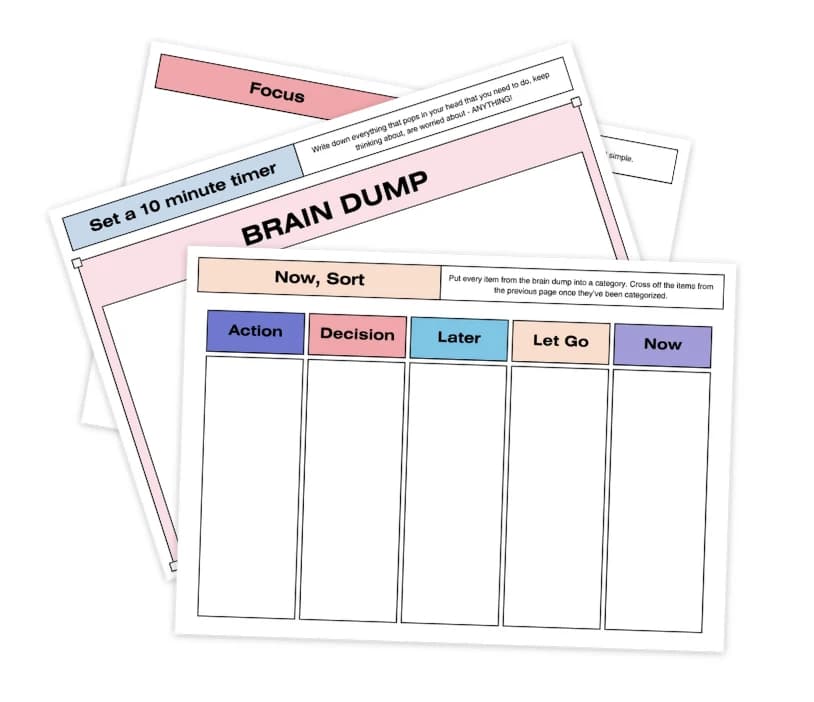
- Page 1 — Brain dump: set a 10-minute timer, then write down everything that pops into your head: things you need to do, thoughts you keep replaying, worries, loose ends — anything. No sorting yet.
- Page 2 — Now, sort: move each line into Action, Decision, Later, Let go, or Now. As you go, cross items off page 1 once they have a home so nothing lives in two places.
- Page 3 — Focus: a short space to name what you are choosing to prioritize after the sort.
Use the download box right below to grab the PDF. Print it or use it on a tablet.
Related reading:
Why this works (For the curious)
Overthinking often comes from a useful trait: you care deeply about outcomes. The problem starts when that care turns into cognitive overload.
There is an important distinction psychologists make: reflection is purposeful and time-limited; rumination is repetitive, passive, and open-ended. Reflection helps you move toward a solution; rumination keeps you circling the problem. People who ruminate tend to fixate on symptoms and their possible causes without moving toward solutions. Over time, this pattern can feed anxiety and keep you stuck.
Common triggers include:
- Too many open decisions at once
- Constant context switching
- No external system to hold thoughts
- Perfectionism that says a good option is not enough
- Mental clutter from unfinished tasks
Most people respond by trying harder to think their way out. That usually backfires. Psychologists call this the "White Bear Effect": the harder you try to force yourself not to think about a white bear, the more polar bears you see. You cannot solve an over-active brain by telling it to shut up. What helps is offloading, simplifying, and executing in small loops.
A useful reframe: clarity does not always come before action. It often comes from action.
Conclusion
Mental clarity for overthinkers is built, not found. When you capture your thoughts, simplify decisions, and act on the next visible step, your mind gets quieter and your day becomes more intentional.
Your next step today: use the printable section above (or open the PDF directly, or a blank page). Set a 10-minute timer for page 1, sort on page 2, then complete one visible action from Now or Action before you do anything else.
Note: Bounded overthinking is a normal human response to high-stress schedules. However, if your racing thoughts make it impossible to sleep, work, or function for more than two weeks, please speak to a licensed clinical therapist.