If journaling feels like another thing you should be doing, you're not alone. So many people avoid journaling because they think it has to be long, deep, emotional, or beautifully written.
But here's the truth: you don't need paragraphs to change your life.
Sometimes the most calming, grounding reflections are the ones you capture in a single sentence, a single word, or even a single emoji.
Today, you'll learn how to journal without writing paragraphs, why it works so well for anxious or overwhelmed minds, and 25+ guided prompts you can use anytime.
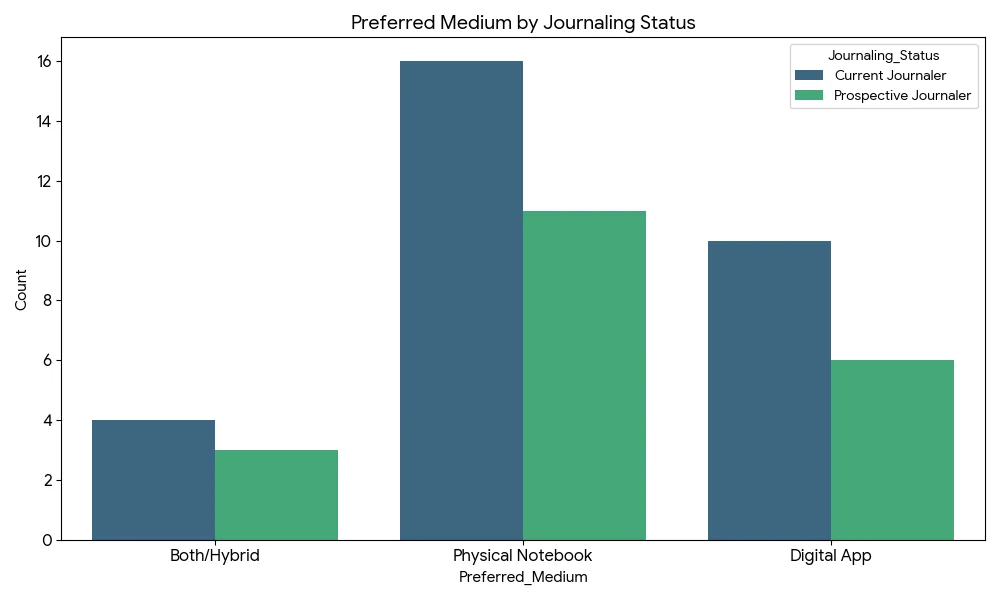
If you want a little more structure, you can do the same prompts in a notebook, a notes app, or any guided check-in that lets you tap or write short answers.
The power of journaling without writing paragraphs
Paragraph-free journaling works because it removes the exact things that make journaling stressful: pressure, perfectionism, and the belief that you need a whole story.
When you write less, you actually notice more.
Why short formats work
Research on expressive writing suggests that brief, regular reflection can help reduce stress and improve emotional clarity (Pennebaker, 1997; Smyth et al., 2018). Short formats may also help by:
- Lowering the barrier so you show up more often.
- Focusing your brain on what matters right now.
- Building small wins that make consistency easier.
- Removing guilt when you don't feel like filling a full page.
This style is perfect for people who are busy, anxious, or tired, or who simply want a lighter way into self-awareness.
How this differs from journaling without writing
We have another post on journaling without writing that focuses on wordless methods: voice memos, photo journals, doodles, movement, and conversation. This post is about a narrower middle ground: formats that still use words, but not paragraphs. Think one-word answers, single sentences, bullet lists, and emoji. If you want to keep language but lose the long-form pressure, you're in the right place.
How to journal without writing paragraphs (even if you're busy)
You don't need paragraphs. You don't even need full sentences. You just need a moment of honesty.
Here are simple formats you can use daily, with notebook and app options for each:
1. One-word journaling
A single word that captures your inner weather.
When to use this: You have thirty seconds and want a quick temperature check on your mood.
- Notebook: write one word at the top of the page.
- App or notes app: type the word into a daily note or prompt.
Examples: "Tired," "Hopeful," "Restless."
One word can tell you so much.
2. Single-sentence check-ins
A micro reflection that captures the essence of your day.
When to use this: You want to name something specific without explaining it.
- Notebook: write one sentence under the date.
- App or notes app: use a prompt like "Today I need..." and answer in one line.
Examples:
- "Today I need..."
- "Right now I feel..."
- "One thing I'm proud of is..."
3. Emoji journaling
Emoji is a language. Use it.
When to use this: Words feel too heavy or you want a visual snapshot.
- Notebook: draw or write the emoji next to the date.
- App or notes app: drop the emoji into a mood tracker or note.
Examples:
- 😌🌿💛 = calm, growing, grateful
- 😠🌪 = frustrated + overwhelmed
- 😴☕ = tired but trying
4. Lists instead of paragraphs
Lists force clarity and stop overthinking.
When to use this: Your thoughts are scattered and you want to sort them fast.
- Notebook: use bullet points on a small page.
- App or notes app: make a checklist or numbered list.
Examples:
- Three things draining me
- Three things giving me energy
- Three things I want to remember
Lists feel like a friend helping you organize your thoughts.
5. Tap-based or choice-based journaling
If you want reflections without writing full sentences, use guided questions with preset answers.
When to use this: You want structure but don't want to compose anything.
- Notebook: write the question and circle a short answer from a list you made.
- App: look for a guided check-in that lets you tap or select a response.
This turns self-reflection into quick choices that still build a real habit.
25+ journal prompts (no paragraphs required)
Use these anytime you want clarity without the pressure to write a lot.
Daily clarity prompts
- Today I'm grateful for...
- My energy level is...
- One thing I'm avoiding is...
- A feeling that's lingering today...
- One win from today...
Emotional check-in prompts
- Right now my body feels...
- Emotion I'm trying to ignore...
- Emotion I want to feel more of...
- One thing that would help me feel supported...
Anxiety-friendly prompts
- What's making me tense...
- Something I can release today...
- One tiny thing that would make today easier...
- I feel safe when...
Habit and consistency prompts
- My priority today is...
- One thing future me would thank me for...
- Something I want to keep doing...
- Something I'm ready to stop doing...
Growth and self-reflection prompts
- A boundary I'm learning to set...
- A truth I'm finally admitting...
- A dream I'm quietly holding...
- A pattern I'm breaking...
What makes this style so calming?
Your brain loves shortcuts.
When you give yourself permission to write less, your mind opens more. This kind of journaling works especially well if:
- You deal with anxiety or overthinking
- You're short on time
- You struggle with consistency
- You hate blank pages
This method isn't about being a "good writer." It's about being a more honest version of yourself.
If you've ever felt guilty about not writing enough in your journal, let this be your permission slip: you're allowed to keep it simple.
Try the no-writing journaling method this week
Imagine seven days from now: clearer, calmer, more grounded, and zero guilt because you found a journaling style that fits your life.
Pick one format from this post and try it for a week. You can use a physical notebook, your phone's notes app, or a guided check-in that offers short prompts.
You deserve a journaling practice that meets you where you are.
Let it be simple.