You know the cycle. You wake up feeling heavy.
Maybe it's anxiety.
Maybe it's burnout.
Maybe it's just a vague sense of too much.
So, you decide to "fix" it.
You read the articles. You listen to the podcasts. They all point you toward two gold standards of mental wellness: Mindfulness (Meditation) or Journaling.
So you try them. You download a mindfulness app. You open a journaling app. You commit to a 30-day streak.
But by day four, the notifications are piling up. By day seven, you're swiping them away with a twinge of guilt. By day ten, you've stopped opening the apps entirely.
It's easy to blame yourself here. It's easy to think,
"I lack discipline."
But what if the problem is that both of these methods, despite their benefits, demand something that your exhausted brain just can't afford to give right now?
What if instead of you needing to work harder at this, the tool needs to ask less of you?
The Mindfulness Struggle: When silence gets loud
The promise of mindfulness is seductive. It sells us the idea of an "off switch."
We gravitate toward it because we want the world to stop spinning. We want a soothing voice to tell us to breathe in, breathe out, and let the clouds of our thoughts drift away.
We want to numb out the pain in ten minutes so we can survive the next eight hours.
Mindfulness requires effort.
It's like training your brain like a muscle.
It requires the mental strength to think about nothing.
When you are depleted, you don't have that strength.
It can actually take away spoons from things you really need to do.
Sometimes a mindfulness practice heals.
But sometimes, you don't need to be strong.
You need to feel supported.

The Journaling Trap: Why you can't stay consistent
If silence doesn't work, maybe expression will.
You turn to journaling. The logic is sound: you need to get the thoughts out of your head to make sense of them. You want to analyze the chaos, find the patterns, and solve the problem.
Research supports that reflecting on what's going on with you is key to making better decisions. A meta-analysis by Smyth (1998) in the Journal of Consulting and Clinical Psychology found that expressive writing produced significant reductions in anxiety and depression across 13 studies. More recently, Reinhold et al. (2018) confirmed these effects across 146 studies.
But then you open the app. The screen is white. The cursor is blinking.
DEER. IN. HEADLIGHTS.
We often forget that writing is cognitive labor.
It uses the same part of your brain that you use to write emails, Slack messages, and reports all day long.
When you are emotionally exhausted, the last thing your brain wants to do is construct sentences, worry about grammar, and find the "perfect word" to describe your pain.
You don't always encounter the anxiety of the blank page, but sometimes, even if you push yourself to ramble a bit about what happened that day, it's next to impossible to get something meaningful down on paper.
You write things like:
"Today I woke up, I had coffee, I was annoyed at the meeting, and then I came home."
You're just transcribing your schedule.
You aren't processing your emotions.
So what is the point?
The "third way": Guided reflection
Mindfulness asks you to be still (which is rewarding, but hard).
Journaling asks you to create (which is hard to stay consistent with).
But what if there was a middle ground? What if you could get the emotional release of journaling without the cognitive heavy lifting of coming up with the sentences?
This is where Guided Reflection (or "Wordless Journaling") comes in.
Instead of staring at a blank page and asking yourself,
"What should I write?"
A guided system asks you,
"How are you, really?"
It turns a simple check-in into a deep reflection.
It removes the burden of being the writer and lets you just be the subject.
You don't have to invent the language for your feelings.
You just have to acknowledge them.

Understanding how our brains respond to recognition vs. recall helps explain why guided reflection feels easier.
Why "wordless" works for the tired brain
Swapping "writing" for "answering" works because:
-
It removes the effort of deep thinking
-
There's no 'performance' or pressure to write well
-
You are much more likely to be consistent, because it's easy and fast
Finding your mix
Don't delete your meditation app.
Keep your leather-bound notebook.
Those tools have their place. But if you find yourself avoiding them because they feel like chores, you have another approach available.
One that doesn't guilt you.
One that is just there.
Research on habit formation by Wendy Wood found that the most sustainable habits are the ones with the lowest friction: the ones that require almost no decision-making to initiate (Wood & Rünger, 2016). A guided check-in that takes under two minutes and requires no writing fits this model precisely.
That's honestly one of the best things about a well-designed guided system: no guilt, no shame. It's designed with pure gentleness.
This is your sign to stop pushing.
You don't always need to articulate your pain to process it. Sometimes, you just need to answer the right question. Pick the insight that resonates.
You don't have to carry all that emotional load.
How to try guided reflection
You don't need a specific app to experiment. You can create your own low-friction check-in by asking yourself one structured question each day, such as:
- "What feeling is taking up the most space right now?"
- "What's one thing I need today?"
- "What's one thing I'm carrying that I can set down?"
Answer in a few words, out loud, or by picking from a short list of options. The goal isn't to produce a journal entry. It's to notice what's going on inside you without adding another task to your day.
A few apps and tools now offer this kind of wordless or guided check-in experience, including Jour and Woebot. If you're curious, try a couple and see which design feels least like work to you.
Frequently Asked Questions
Is this the same as a mood tracker?
It's similar, but with more depth. A mood tracker just asks "Are you happy or sad?" Guided reflection helps you understand why you feel that way, without forcing you to write a novel about it.
Can I use this and meditate?
Absolutely. Many people use guided check-ins to "clear the decks" before they meditate. It's often easier to sit in silence once you've acknowledged what's bothering you.
Is digital journaling as effective as paper?
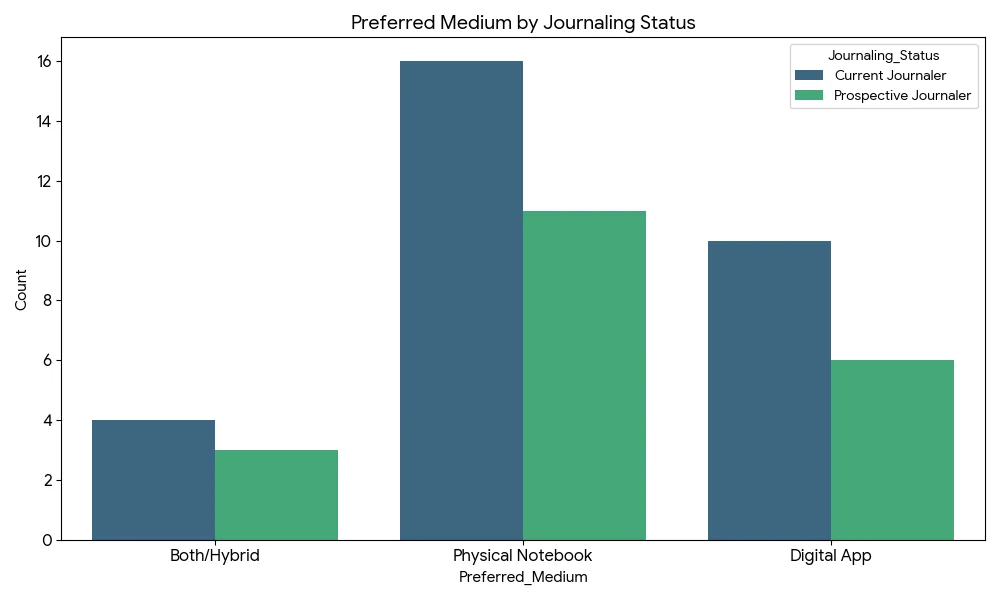
The science says the "medium" matters less than the "habit." If a paper journal stays closed in your drawer, it's 0% effective. If a digital app helps you check in with yourself daily because it's convenient, it's infinitely better.