The kids are finally down. The house is, for the first time in 12 hours, completely silent. This is the moment you've been waiting for all day: the window to finally "rest."
But instead of sleeping, or reading that book on your nightstand, you find yourself slumped on the sofa, mindlessly scrolling through 45 minutes of strangers' kitchen renovations and "life hacks" you'll never use.
It's easy to call this "laziness" or "lack of discipline." But the behavioral science suggests something much more specific is happening in your brain.
You aren't scrolling because you're relaxed. You're scrolling because your exhausted brain is doing what it was designed to do: conserve energy.
The "Stress-Habit Switch"
In cognitive science, the brain is understood as a balance between two competing systems: Goal-Directed Behavior and Habitual Automaticity.
- Goal-Directed Behavior: This happens in your Prefrontal Cortex. It's where you make complex decisions, plan for the future, and exercise willpower. Research by Miller and Cohen (2001) in Annual Review of Neuroscience established the prefrontal cortex as the brain's executive control center — and it is metabolically expensive to run.
- Habitual Automaticity: This is managed by the Basal Ganglia (specifically the Dorsal Striatum). These are your "autopilot" loops. Research by Graybiel (2008) in Annual Review of Neuroscience showed that habit formation involves a shift from goal-directed to automatic control in the basal ganglia. These loops are fast, rigid, and require almost zero energy.
When you spend all day managing schedules, negotiating with toddlers, and navigating work, your Prefrontal Cortex is running at a massive deficit. This is what researchers call Cognitive Depletion. Baumeister and colleagues' foundational research on ego depletion found that willpower functions like a muscle — it fatigues with use (Baumeister et al., 1998). A meta-analysis by Hagger et al. (2010) in Psychological Bulletin reviewed 83 studies and confirmed that self-control resource depletion reliably impairs subsequent self-regulatory performance.
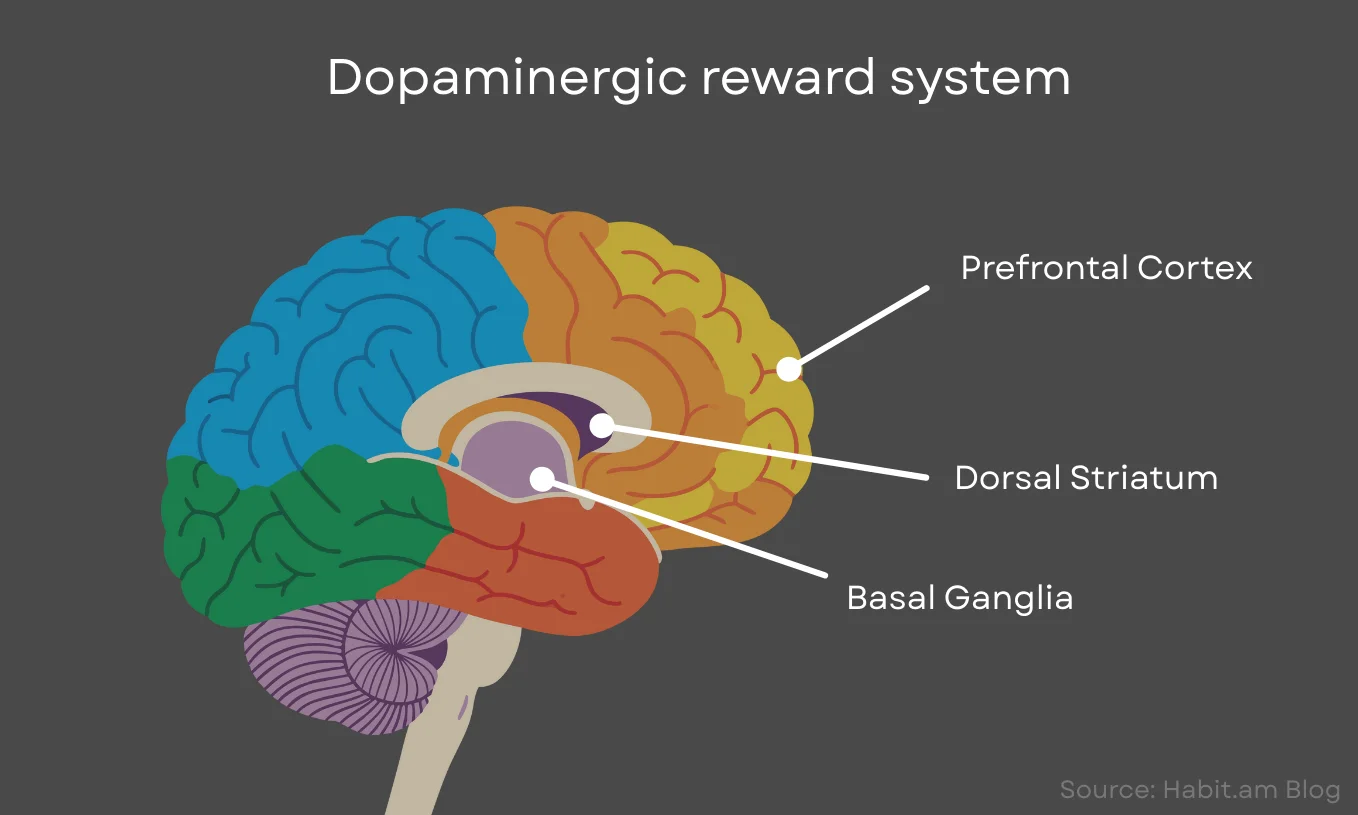
By 9:00 PM, your brain performs what neuroscientists call a "Stress-Habit Switch." It shuts down the expensive Prefrontal Cortex and hands the wheel to the Striatum. You scroll because scrolling is a "pre-packaged" behavioral loop. It requires zero decision-making power, which is exactly why your depleted brain prefers it to the "work" of actual relaxation.
The Paradox of Choice and Intermittent Reinforcement
Surprisingly, true rest requires more cognitive energy than scrolling. To "relax" properly — by meditating, journaling, or even just deciding to go to bed — you have to make a choice. You have to exert goal-directed control. For a brain that has been making thousands of micro-decisions all day, the idea of making one more choice feels like decision fatigue.
Research by Vohs et al. (2008) in the Journal of Personality and Social Psychology found that making decisions depletes the same self-regulatory resource used for self-control. The more decisions you make, the harder subsequent decisions become — and the more likely you are to choose the easiest option.
Scrolling provides Intermittent Reinforcement. Every fourth or fifth post gives you a tiny hit of dopamine. Research on variable ratio reinforcement schedules — first described by Skinner (1957) and now well-documented in behavioral neuroscience — shows that unpredictable rewards create the most persistent behavior. It's just enough of a reward to keep the loop spinning, allowing your brain to stay in "autopilot" while avoiding the silence of its own thoughts.
You aren't addicted to the phone; you are avoiding the "computational cost" of switching your brain back into a goal-directed state.
How to Close the Loop
If you want to break the cycle, you don't need more willpower. You need to reduce the "cost" of the better habit.
Research on habit formation by Wendy Wood at the University of Southern California found that the most reliable way to change behavior is through Environmental Design — restructuring your physical environment so that good habits become easier than bad ones (Wood & Rünger, 2016).
- Decrease the Friction of Rest: If your book is already open on the couch and your phone is in another room, the "cost" of reading drops below the "cost" of scrolling.
- Use Low-Energy Reflection: If the thought of a blank journal page feels like a high-energy chore, try a structured method. Research shows that reducing cognitive load through guided prompts can interrupt ruminative loops (Kross et al., 2014). Even brief emoji reflections or guided check-ins can help transition your brain from autopilot to intentional rest.
- Create Physical Barriers: Put your phone in a high place in another room. The small act of standing up to retrieve it introduces enough friction to break the automatic loop.
A practical tip for overwhelmed parents: Instead of letting the night vanish into the scroll, try putting your phone in another room, sitting on the couch, and doing two minutes of relaxed breathing. Then, ask yourself what you actually want to do with the 30 minutes you have to yourself. That single moment of intention — however brief — is what moves your brain from habitual automaticity back to goal-directed behavior.
When to seek help: If your nighttime scrolling is accompanied by persistent insomnia, anxiety that interferes with daily functioning, or feelings of hopelessness, these may be signs of a deeper mental health issue. Consider speaking with a licensed therapist or your primary care provider. The 988 Suicide & Crisis Lifeline (call or text 988 in the United States) is available 24/7.