Habit - Guided Journaling App LogoHabit

How to Journal Without Ruminating

Your brain thinks it's solving something, but it might just be rehearsing the problem. Try a guided check-in that interrupts the loop and points you forward.

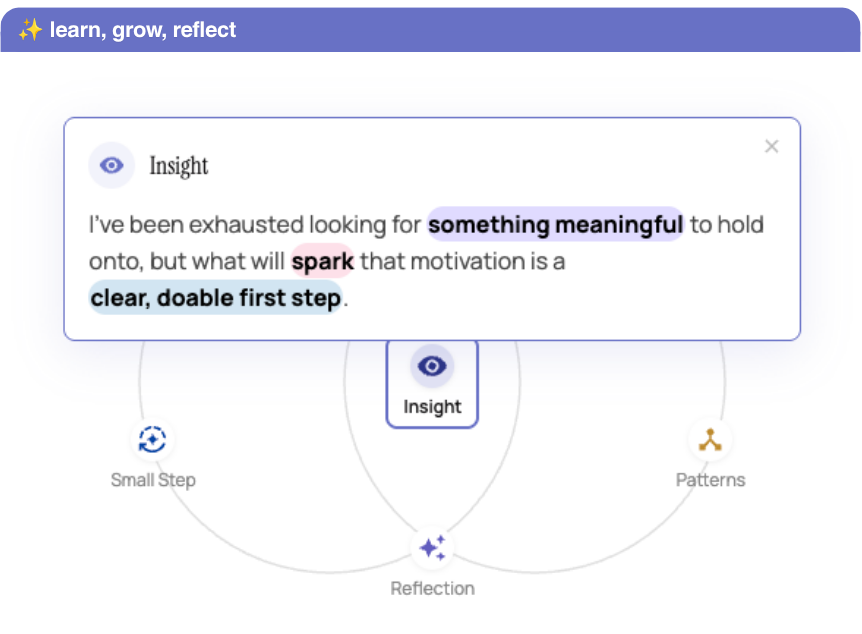
Insight Map

Insight

Deeper Current

Ground Truth

Small Step

Patterns

Reflection

Insight

I'm learning that my rumination isn't problem-solving; it's my brain's attempt to feel in control of something that can't be controlled.

Complete a check-in to generate your own insight map.

This is for:

  • People who replay conversations in their head for days

  • Anyone who journals to 'figure things out' but never does

  • People whose mental playlists are on infinite repeat

  • Those who feel stuck despite thinking about their problems constantly

  • Anyone who uses reflection as a substitute for action

A quote about recognizing personal progress and the hope that comes from pausing to look back at how far you've come.

What you've tried vs. what actually works

The Old Way

  • Think about a problem for hours.
  • Write about it to 'process.'
  • Re-read what you wrote and think about it more.
  • Still haven't done anything about it.

The Habit Way

  • Answer questions that move from observation to insight to action.
  • Each question has a purpose, no open-ended loops.
  • Get an insight that points to a next step, not more analysis.
  • Close the loop. Move on.

Your brain thinks it's solving something. It might just be rehearsing.

Rumination is sneaky. It feels like problem-solving. It looks like diligence. Your brain convinces you that if you just think about it enough, you'll find the answer. But rumination isn't problem-solving, it's problem-rehearsing. You're not moving toward a solution. You're running laps around the same worry.

And journaling, without structure, is one of the best venues for rumination ever invented.

Why journaling can be rumination with better stationery

Give an overthinking brain a blank page and watch what happens:

  • It rehashes the same conversation for the hundredth time.
  • It generates elaborate hypothetical scenarios.
  • It writes elaborate analyses of situations that can't be analyzed into resolution.
  • It convinces itself that all this thinking is "processing."

Call it processing if you want. What it really is: looping. And every loop strengthens the neural pathway that says: thinking about this is the same as handling it.

How to interrupt the thought loop without ignoring it

The goal isn't to stop thinking about your problems. The goal is to think about them productively, to move from observation to insight to action, instead of circling the same drain forever.

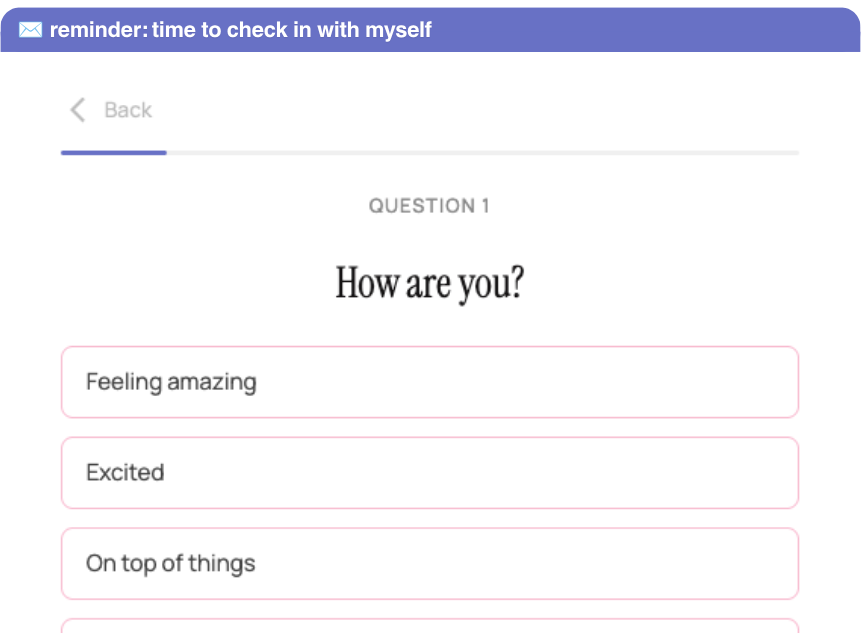
A guided check-in interrupts rumination by:

  • Giving you one question at a time... no room for tangents
  • Progressing from surface to depth... each question builds on the last
  • Ending with an insight... a pattern, a mantra, a small step
  • Closing the loop... you finish. You don't keep writing.

You still think about your problems. You just stop rehearsing them.

The question that breaks the cycle

The most powerful question in any guided check-in isn't the deepest one, or the most profound. It's the one that asks: What would you do right now if you stopped thinking about this?

That question breaks the spell. It reminds you that rumination feels like action but produces nothing. Real action feels smaller, quieter, and often scarier, because it actually changes something.

How to journal without ruminating

If you want to journal without ruminating, you need structure that points forward. A guided check-in gives you one question at a time, progresses from surface to depth, and ends with a small step. You still think about your problems. You just stop rehearsing them.

Try a check-in that moves you forward

Seven questions. Two minutes. One insight that doesn't ask you to think more, it asks you to see clearly enough to move.

Stop rehearsing. Start reflecting.

Start Free Check-in
Noemi, creator of Habit.

Why this matters

“I used to spend hours in my journal 'figuring things out.' I had notebooks full of analysis and zero pages of action. What I needed wasn't more thinking, it was a structure that turned thinking into clarity.”

— Noemi, founder of Habit

Read our story

100% Private AI

Your thoughts and reflections are completely secure.

Grounded in robust research

Designed to help you build resilience and calm.

Instant Access Anywhere

Works on any device.

Read more on this topic
  • Mental clarity for overthinkers
  • Why do i feel overwhelmed for no reason
  • Productivity systems that work with your brain not against it

Got more questions?

Dive into our FAQ to see why so many people choose Habit

Visit the FAQ
Try a check-in that moves you forward
Try Habit

About

Pricing

BlogHelp

FAQ

Contact

Terms & Privacy

Free Resources

Random Journal Prompt GeneratorExplainer: Guided Journal PromptsInteractive Breathing ExerciseFeeling Identifier Quiz

For Professionals

Journaling Tool for TherapistsJournaling Tool for ADHD CoachesJournaling Tool for Life Coaches

© 2026 Habit. All rights reserved.

Build version: v2.18.6