You don't hate reflecting. You hate the performance of it.
Somewhere along the way, journaling became a genre. Instagram-worthy spreads. Morning pages at 5 AM. Three pages of uninterrupted stream-of-consciousness before your coffee gets cold. The journal industrial complex sold you a fantasy: that real reflection looks like poetry, that consistency means daily, that your inner life should be legible and beautiful.
No wonder you hate it.
You don't hate knowing yourself. You hate the performance of knowing yourself, the pressure to be articulate, profound, and consistent in a medium that gives you nothing back.
The journal industrial complex lied to you
Let's be honest about what traditional journaling asks of you:
- Initiative: You have to decide what to write about, every single time.
- Articulation: You have to turn feelings into sentences, even when you don't have words yet.
- Consistency: You have to show up daily, or you've "failed."
- Depth: If you're not writing pages, you're not doing it "right."
That's not a reflection practice. That's a writing assignment with no deadline and no feedback. Of course you avoid it. Your brain is trying to protect you from another obligation.
What happens when you remove the blank page entirely
Guided check-ins work because they remove the parts of journaling that create resistance:
- No blank page → You never start from zero.
- No open-ended prompts → You respond to specific questions that build on each other.
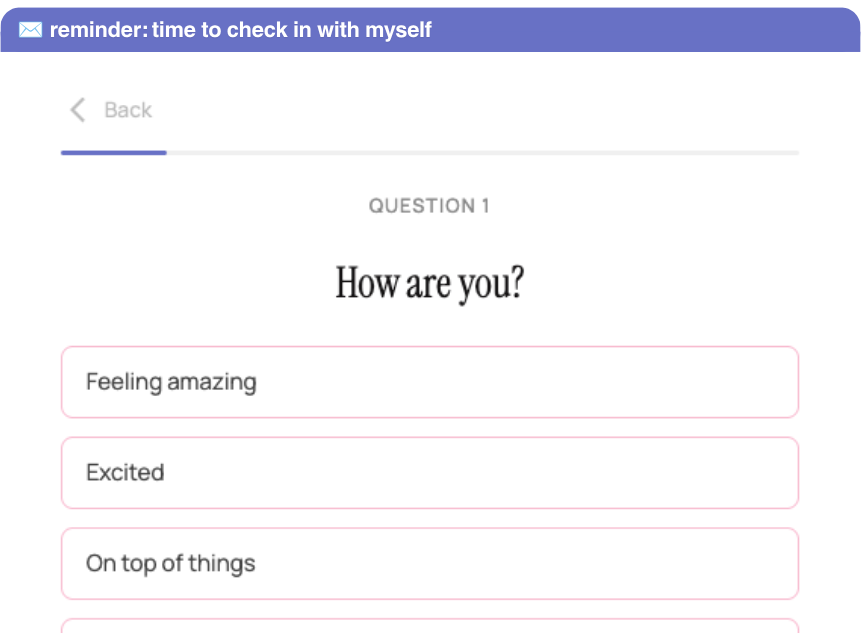
- No writing required → Tap answers. Choose options. No paragraphs.
- No streaks or guilt → Check in when you need it. Skip when you don't.
The result? You actually reflect. Not because you're disciplined. Because it's finally easy.
"But I bought so many pretty notebooks"
Those notebooks aren't evidence of failure. They're evidence that you want to reflect, you just haven't found a way that fits your brain. Keep the notebooks. Use them for lists, sketches, or nothing at all. Your reflection practice doesn't need to live on paper.
Habit is less a journal and more a conversation someone else starts so you can just answer.
What to do if you hate journaling
If you hate journaling, you are not broken. You just haven't found a format that respects your energy. A guided check-in removes the blank page, the streak pressure, and the expectation to be profound. It gives you the benefits of journaling without the parts that make you want to quit.
Try a check-in that asks, not demands
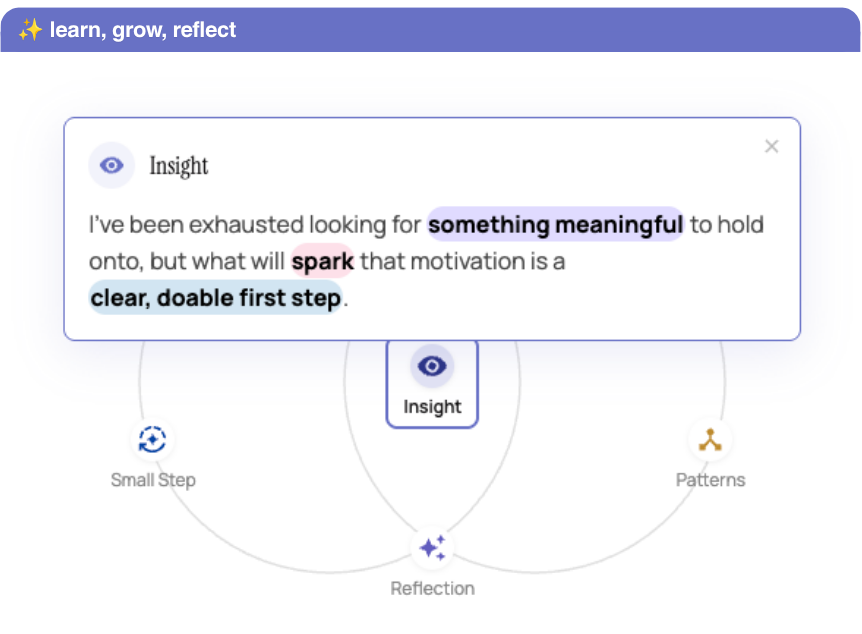
One question. Two minutes. No blank page. No pressure to be profound. Just you, answering honestly, and getting an insight that actually makes sense.
You could call it journaling, or you could call it something better.