Habit - Guided Journaling App LogoHabit

How to Journal Without Spiraling

Traditional journaling gives anxious thoughts more room to run. Use a structured check-in that names the feeling and closes the loop.

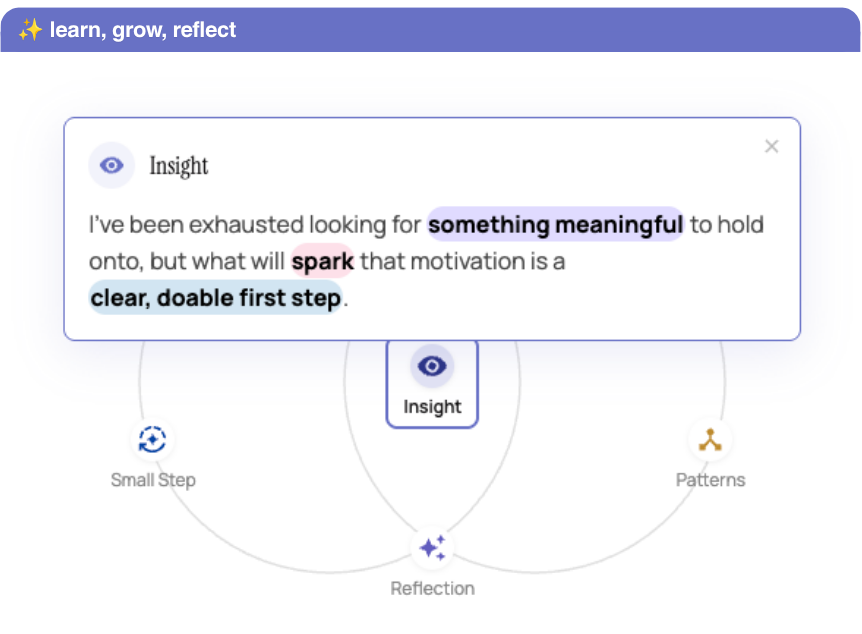
Insight Map

Insight

Deeper Current

Ground Truth

Small Step

Patterns

Reflection

Insight

I'm learning that my anxiety isn't random, it spikes when I try to 'solve' feelings that don't have solutions yet.

Complete a check-in to generate your own insight map.

This is for:

  • People whose journals make them feel worse after writing

  • Anyone who starts with one worry and ends with twelve

  • People who can't stop once they start writing about anxiety

  • Those who use journaling to vent but never feel better

  • Anyone whose 3 AM thoughts feel more real on paper

A calming mandala of coral and pink dots radiating outward, suggesting centeredness and emotional grounding.

What you've tried vs. what actually works

The Old Way

  • Start writing about one worry.
  • Connect it to every other worry you've ever had.
  • End with a full catastrophe narrative.
  • Close the journal feeling more anxious than when you opened it.

The Habit Way

  • Answer questions that build toward insight, not amplification.
  • Each question has a natural endpoint. No open loops.
  • Get an insight that closes the loop instead of extending it.
  • Walk away knowing what you feel, not just what you fear.

Your journal became a worry echo chamber

You opened your journal to feel better. You closed it feeling worse. Not because you're doing it wrong, but because traditional journaling has no guardrails. Give a worried brain a blank page and it will fill it with every worst-case scenario, every unresolved tension, every what-if that ever crossed your mind.

Your journal became a place where anxiety goes to breed.

Why writing it out makes the spiral worse

There's a dangerous myth in mental health culture: "Get it out on paper." But for people with anxiety, getting it out doesn't always help. Sometimes it just gives your worries a permanent home. You write them, you re-read them, you add to them. The page becomes evidence that things are as bad as you think.

Research on emotional processing shows that venting without structure can actually increase distress. You need more than expression. You need direction.

What the feeling really is (and how to name it without drowning in it)

Anxiety feels urgent. It convinces you that if you don't figure it out right now, something terrible will happen. But most anxious thoughts aren't problems to solve, they're feelings to witness.

A guided check-in interrupts the spiral by:

  • Naming the emotion before you analyze it
  • Locating it in your body instead of your narrative
  • Asking one question at a time instead of handing you a blank page
  • Closing with an insight that gives you perspective, not more problems

You don't need to solve your anxiety. You need to see it clearly enough to stop feeding it.

The difference between venting and insight

Venting feels like release in the moment, but it often reinforces the same neural pathways. Insight feels quieter... it's the moment you recognize a pattern instead of repeating it.

Guided check-ins are designed for insight. Each question builds on the last, moving you from surface emotion to deeper awareness without ever dropping you into an open-ended spiral.

How to journal without spiraling

If you want to journal without spiraling, you need guardrails, not a blank page. A guided check-in names the feeling first, locates it in your body, and closes with insight instead of opening new loops. You get the release of expression without the amplification of anxiety.

Try a check-in that closes the loop

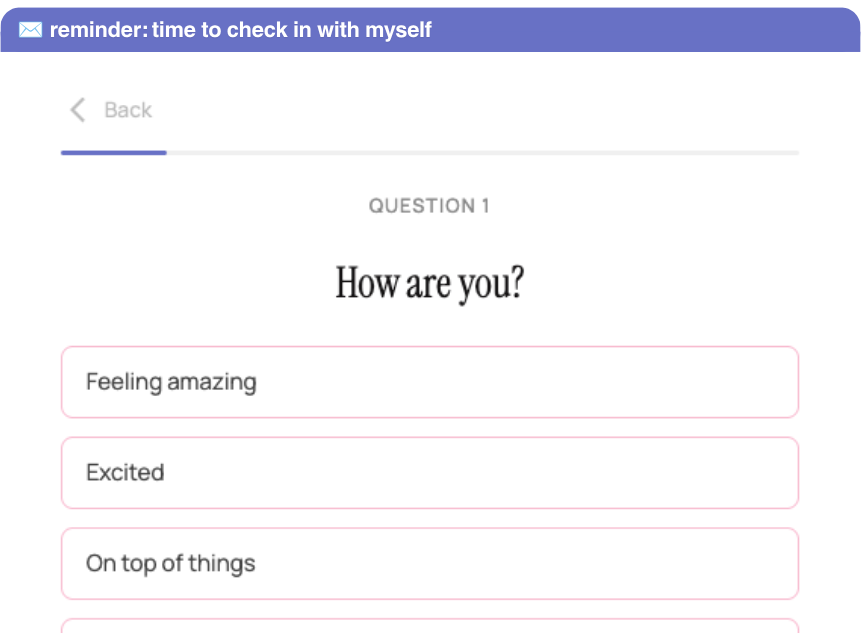
Two minutes. Seven questions. One insight that doesn't ask you to solve anything... just to see it clearly.

Close the journal feeling lighter, not heavier.

Start Free Check-in
Noemi, creator of Habit.

Why this matters

“I used to journal at 2 AM when anxiety wouldn't let me sleep. I'd write for an hour and end up more wired than when I started. What I needed wasn't a place to vent, it was a place to land.”

— Noemi, founder of Habit

Read our story

100% Private AI

Your thoughts and reflections are completely secure.

Grounded in robust research

Designed to help you build resilience and calm.

Instant Access Anywhere

Works on any device.

Read more on this topic
  • How to journal for anxiety
  • Mental clarity for overthinkers
  • Daily self reflection reduces anxiety symptoms

Got more questions?

Dive into our FAQ to see why so many people choose Habit

Visit the FAQ
Try a check-in that closes the loop
Try Habit

About

Pricing

BlogHelp

FAQ

Contact

Terms & Privacy

Free Resources

Random Journal Prompt GeneratorExplainer: Guided Journal PromptsInteractive Breathing ExerciseFeeling Identifier Quiz

For Professionals

Journaling Tool for TherapistsJournaling Tool for ADHD CoachesJournaling Tool for Life Coaches

© 2026 Habit. All rights reserved.

Build version: v2.18.6