Habit - Guided Journaling App LogoHabit

How to Track Mood Between Therapy Sessions

Your therapist only sees the summary. Capture the data in between with a 30-second check-in, so you walk into your next session with patterns, not paragraphs.

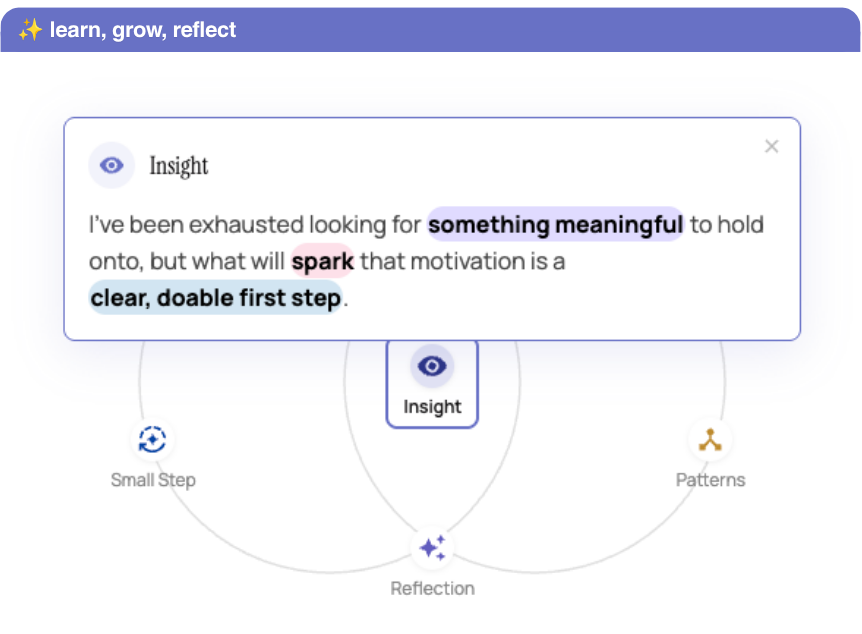
Insight Map

Insight

Deeper Current

Ground Truth

Small Step

Patterns

Reflection

Insight

I'm learning that my mood isn't random, it follows patterns my conscious mind can't see until I look back.

Complete a check-in to generate your own insight map.

This is for:

  • People in therapy who forget what happened between sessions

  • Anyone who walks into therapy and draws a blank

  • People whose moods swing but they can't name the trigger

  • Those who want therapy to be more focused and less repetitive

  • Anyone who feels like they waste the first 10 minutes of every session catching up

A quote about noticing how much you've grown, reflecting the kind of pattern recognition that makes therapy more effective.

What you've tried vs. what actually works

The Old Way

  • Try to remember your week in the waiting room.
  • Vague descriptions: 'I've been fine, I guess.'
  • Miss patterns because you only see one moment at a time.
  • Leave sessions feeling like you forgot the important thing.

The Habit Way

  • Quick mood checks that take 30 seconds.
  • Patterns emerge automatically in your insight map.
  • Walk into therapy with actual data, not just memory.
  • Your therapist sees the arc, not just the snapshot.

Your therapist only sees the summary. The data is in between.

You sit down in the chair and your mind goes blank. "How was your week?" your therapist asks, and you realize you have no idea. Not really. You remember the fight with your partner, maybe. The bad night of sleep. But the texture of the week, the slow shifts, the micro-moments, the patterns that actually explain why you feel the way you do, it's gone. Dissolved into the fog of living.

This isn't your fault. Memory is a terrible tool for emotional tracking. It privileges intensity over frequency, drama over drift. The quiet Tuesday afternoon where you felt suddenly hopeless? Gone. The three good days before the crash? Condensed into "fine, mostly." Your therapist is trying to map a landscape from a Polaroid.

Why "session amnesia" kills therapy progress

Therapy works through pattern recognition. You and your therapist are trying to see the shape of your inner life, the triggers, the defenses, the recurring loops. But patterns require data over time, and human memory is spectacularly bad at providing it.

What you remember from a week is a highlight reel weighted toward emotionality. What your therapist needs is the box score, the frequency, the context, the antecedents. Without it, every session starts from zero. You spend the first fifteen minutes reconstructing a week you already forgot, and by the time you get to the actual work, the clock is running out.

This is why people feel like therapy is "just talking", because without data, talking is all you can do.

The pattern blindness problem

Most people can't see their own emotional patterns while they're living them. The unconscious doesn't announce itself; it whispers through repetition. The same irritation every Tuesday. The same crash every Thursday evening. The same restless energy that precedes every depressive dip.

These aren't coincidences. They're the unconscious speaking in code. And you can't crack the code if you don't write it down.

Mood tracking isn't about being a data nerd, or collecting points for some invisible scoreboard. It's about building the evidence base that lets you and your therapist see what your memory can't hold. The pattern that looks like random suffering up close reveals itself as a coherent signal from a distance.

How 30 seconds between sessions changes everything

The goal isn't exhaustive documentation, or a detailed log of every mood swing. It's enough data to see the shape. One check-in. Thirty seconds. How do you feel? What's present? What's heavy? No analysis, no narrative, no pressure to be profound.

Over weeks, these tiny data points assemble into a map. Your therapist can see the arc, not just the snapshot. You can stop saying "fine, I guess" and start saying "here's what my week actually looked like." The conversation shifts from reconstruction to insight.

How to track mood between therapy sessions

If you want to track mood between therapy sessions, you don't need exhaustive documentation. One 30-second check-in per day builds a map your therapist can actually use. Over weeks, the data reveals arcs and triggers that memory alone cannot hold.

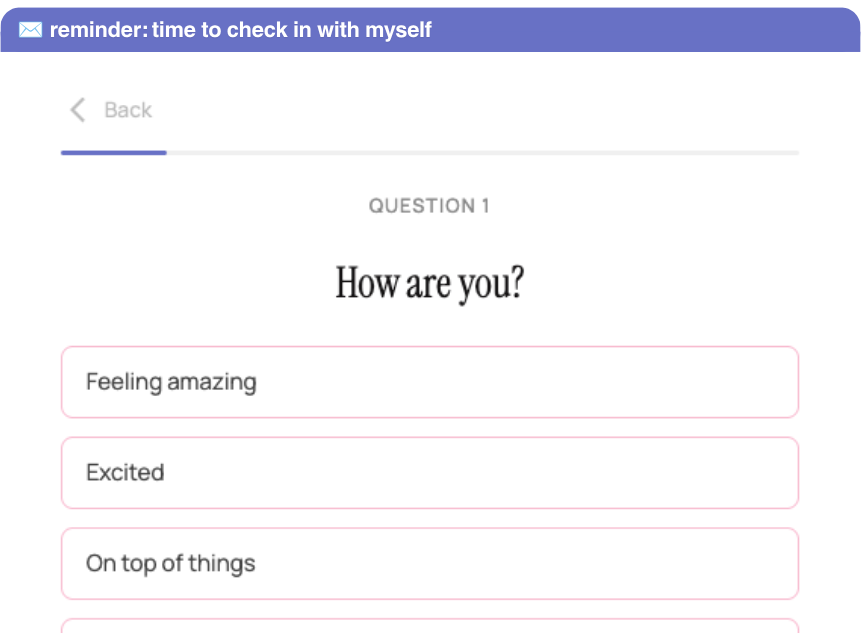
Try a check-in that tracks what therapy misses

Seven questions. Thirty seconds. No paragraphs. Just the data your therapist needs and your memory can't hold.

The space between sessions is where the work actually happens. Start tracking it.

Start Free Check-in
Noemi, creator of Habit.

Why this matters

“I spent years in therapy feeling like I was starting from zero every single week. I could never remember what happened between sessions, and the patterns that mattered most were always just out of reach. What I needed wasn't a better memory; it was a simple way to capture the data my therapist couldn't see.”

— Noemi, founder of Habit

Read our story

100% Private AI

Your thoughts and reflections are completely secure.

Grounded in robust research

Designed to help you build resilience and calm.

Instant Access Anywhere

Works on any device.

Read more on this topic
  • How to prepare for therapy using daily reflection questions
  • How to journal for anxiety
  • Daily self reflection reduces anxiety symptoms

Got more questions?

Dive into our FAQ to see why so many people choose Habit

Visit the FAQ
Try a check-in that tracks what therapy misses
Try Habit

About

Pricing

BlogHelp

FAQ

Contact

Terms & Privacy

Free Resources

Random Journal Prompt GeneratorExplainer: Guided Journal PromptsInteractive Breathing ExerciseFeeling Identifier Quiz

For Professionals

Journaling Tool for TherapistsJournaling Tool for ADHD CoachesJournaling Tool for Life Coaches

© 2026 Habit. All rights reserved.

Build version: v2.18.6