Habit - Guided Journaling App LogoHabit

How to Journal with Guided Emotional Check-Ins

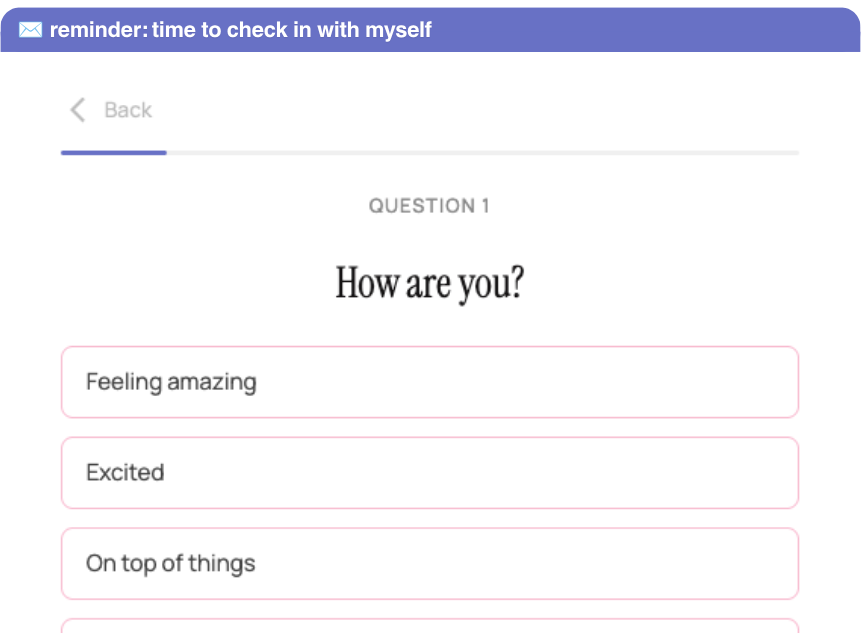
You don't need to know what to write—you just need to answer. Try a 2-minute guided check-in that starts the conversation so your unconscious can respond.

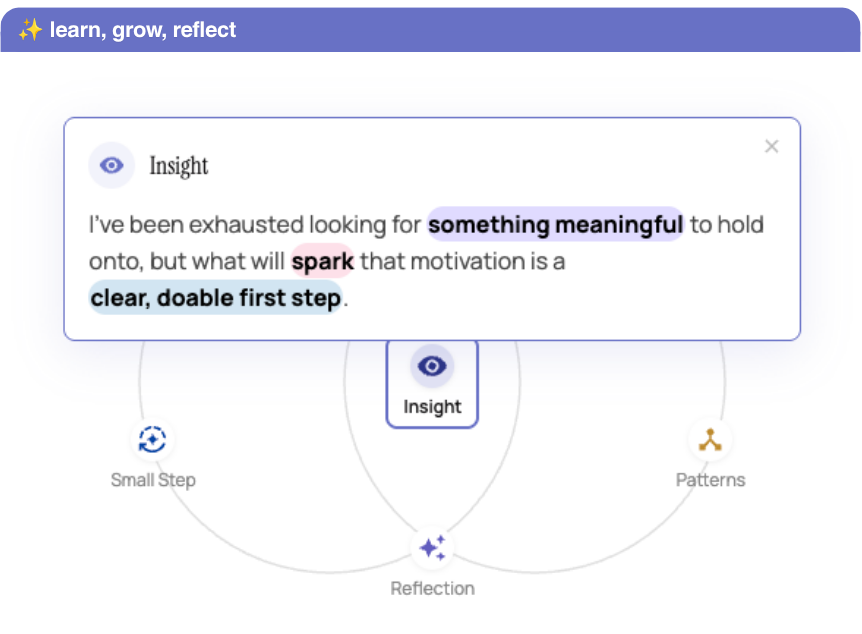
Insight Map

Insight

Deeper Current

Ground Truth

Small Step

Patterns

Reflection

Insight

I'm learning that the hardest part of reflection isn't the answering, or knowing what to say. It's the starting. And when someone else starts for me, I can finally say what I actually feel.

Complete a check-in to generate your own insight map.

This is for:

  • People who want to reflect but freeze at a blank page

  • Anyone who needs structure to access their inner world

  • People who've tried journaling dozens of times and never stuck with it

  • Those who want reflection to feel like a conversation, not a monologue

  • Anyone who knows they feel something but can't name it alone

An illustration of a person looking at their phone with sparkles around them, reflecting the small moments of insight that come from answering guided questions.

What you've tried vs. what actually works

The Old Way

  • Open a blank page and immediately feel the pressure to be profound.
  • Start writing, then judge every sentence before it's finished.
  • Abandon the practice because 'nothing important' came up.
  • Treat reflection as a performance with no audience.

The Habit Way

  • Answer one question at a time. No blank page. No pressure.
  • Each question builds on the last, leading you deeper naturally.
  • Your insight map reveals patterns you couldn't see alone.
  • Reflection becomes a conversation, not a solo performance.

You don't need to know what to write. You just need to answer.

The hardest part of reflection has nothing to do with insight. It has to do with starting. The blank page stares back. Your mind goes quiet, or worse, it goes performative. You write what you think you should feel. You analyze before you experience. You close the journal convinced that your inner life is either empty or too messy to be worth examining.

But the problem isn't you. The problem is the medium. A blank page asks too much. It hands you a microphone and expects a monologue before you've even found your voice.

Why blank pages create resistance

A blank page is an open system. No boundaries, no direction, no container. For people with overactive inner critics, which is most people, an open system isn't freeing, or even neutral. It's terrifying. The ego steps in immediately to manage, curate, and perform. You don't reflect. You produce.

This is why so many people "fail" at journaling. Not because they lack self-awareness, but because the blank page triggers the same performance anxiety that makes them avoid therapy, avoid difficult conversations, avoid looking inward in the first place. The medium creates the resistance.

What Jung understood about structure and the unconscious

Jung developed active imagination as a structured way to dialogue with the unconscious. He didn't sit in a room and wait for insights to arrive. He created containers, rituals, questions, symbolic engagements, that invited the unconscious to speak on its own terms. The structure wasn't a limitation, or a cage for creativity. It was the vessel that made the conversation possible.

A guided emotional check-in works on the same principle. The questions provide the container. Your answers provide the content. The structure holds you so you don't have to hold yourself. And when you're not busy managing the process, the unconscious can finally surface.

The difference between a prompt and a conversation

A prompt is a starting line. A conversation is a path. When you're handed a single prompt, "What are you grateful for?", you're still responsible for generating the insight, the direction, and the depth. A guided check-in removes that burden entirely. Question one establishes presence. Question two locates emotion. Question three finds the pattern. By question seven, you've arrived somewhere you couldn't have planned, because the path led you there.

You didn't need to know where you were going. You just needed to answer honestly at each step.

Why answering is easier than writing

Writing requires initiative, articulation, and continuity. Answering requires only honesty. When someone asks you a question, even an app, even a system, the social and psychological dynamic shifts. You're no longer performing for a blank page. You're responding to an invitation. The pressure dissolves. The truth emerges.

The insight you get at the end isn't a summary of your answers, or a recap of what you already know. It's a pattern distilled from your responses, a deeper current, a quiet truth, a small step forward that makes sense because it came from you, not from the page.

How to journal with guided emotional check-ins

If you want to journal with guided emotional check-ins, you don't need to know what to write. You just need to answer. Each question builds on the last, moving you from surface emotion to deeper awareness. The insight at the end is a pattern distilled from your responses, not a grade on your prose.

Try a check-in that starts the conversation

Seven questions. Two minutes. No blank page. No performance. No requirement to be profound.

Just you, answering honestly, and getting an insight that only the right questions could reveal.

Start the conversation. The unconscious is already listening.

Start Free Check-in
Noemi, creator of Habit.

Why this matters

“I spent a decade filling notebooks every single day. Then I had kids, work, and burnout, and I couldn't do it anymore. What I realized was that the blank page wasn't helping me reflect, or even holding space for it. It was asking me to perform reflection. Guided check-ins gave me a way to be honest without having to generate the honesty from scratch.”

— Noemi, founder of Habit

Read our story

100% Private AI

Your thoughts and reflections are completely secure.

Grounded in robust research

Designed to help you build resilience and calm.

Instant Access Anywhere

Works on any device.

Read more on this topic
  • Can i journal if im bad at writing
  • Journal for lazy people
  • Why journaling feels hard mental resistance

Got more questions?

Dive into our FAQ to see why so many people choose Habit

Visit the FAQ
Try a check-in that starts the conversation
Try Habit

About

Pricing

BlogHelp

FAQ

Contact

Terms & Privacy

Free Resources

Random Journal Prompt GeneratorExplainer: Guided Journal PromptsInteractive Breathing ExerciseFeeling Identifier Quiz

For Professionals

Journaling Tool for TherapistsJournaling Tool for ADHD CoachesJournaling Tool for Life Coaches

© 2026 Habit. All rights reserved.

Build version: v2.18.6